
A Split-Second Collapse. A Life-Saving Response
Keifer Yutzy doesn't remember falling to the floor. He doesn't remember his coworkers shouting his name or the moment his pulse faded. But he is alive today because the people around him did something extraordinary: they didn't hesitate.
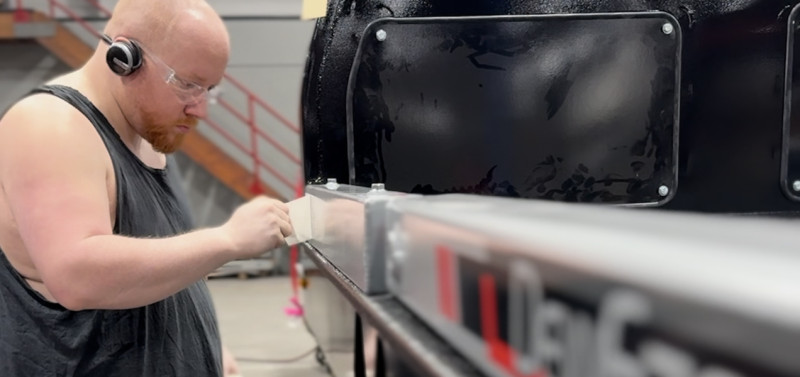
What started as a normal day in final assembly at Harper Industries changed in an instant. Yutzy had been doing what he always does - applying decals, checking final covers, making sure every unit looks how it should. Then, without warning, he went down. A coworker found him struggling to breathe. His skin color changed to shades of red and purple, and before anyone fully understood what was happening, he became unresponsive.
From there, everything moved fast.
Mike Dodd, final assembly supervisor, heard the commotion from upstairs, so he headed down. Before he reached the bottom, someone told him "Keifer's down!" He expected a fall, or even an injury. When the employee told him that Yutzy just collapsed, he knew it was more serious.
Yutzy's eyes were open, but he wasn't responding. His breathing stopped. His pulse faded.
Dodd immediately ran to call 911. By the time he got back to the scene, Yutzy's pulse had stopped. Travis Nichols, quality manager, was administering CPR.
"There were people all around him trying to get him to respond," Nichols said. "When he didn't, we just did what we needed to do."
Dodd grabbed the nearby AED unit.
It was opened, pads were placed and the first shock was delivered. Yutzy came back briefly and then his pulse stopped again. A second shock helped reestablish a heartbeat long enough for EMS to arrive.
Those moments made all the difference, said Carrie Kelly, RN, who worked on Yutzy when he arrived at Patterson Health Center.
"Cardiac arrest is when the heart stops beating effectively and blood can't reach the brain," She said. "After about four minutes of lack of blood flow to the brain, you start seeing brain cells die. Anything more than ten minutes could be detrimental."
Yutzy's coworkers never stopped. Never panicked. Never froze. Because of that, Yutzy is still here. He woke up later that day or the next. He still isn't sure. But he knows that if the AED hadn't been nearby and if his coworkers hadn't known what to do, he wouldn't be here to tell the story.
"I'm glad it was there," he said. "And I'm glad people around me knew how to use it. I would have been a deer in a headlight, just not sure what to do with myself."
For Dodd, one moment sticks with him.
"He walked back in the next Monday," Dodd said. "Less than a week later. I was blown away. I've seen people who didn't make it and we were close - really close."
Kelly agrees that what happened on the factory floor demonstrates why AEDs are so important in workplace.
"There are AEDs everywhere, and it's important for people to be comfortable using it," she said. "It's very crucial to either begin CPR or put an AED on to get that blood flowing again."
Cardiac arrest doesn't wait for medical professionals. It happens fast, and survival depends on what happens in the first few minutes.
Harper Industries employees did every step right to ensure a positive outcome.
- Someone recognized an emergency.
- Someone started CPR.
- Someone got an AED.
- Someone called 911.
- Everyone worked together.
Because of that, Yutzy is still here.
Patterson Health Center offers a full range of cardiac services to support patients before, during and after a heart event.
* Emergency cardiac care - Immediate stabilization and treatment 24/7.
* Two visiting cardiologists
Dr. Husam Bakdash, MD, FACC available the 2nd and 4th Thursday. Call 316-686-5300 to make an appointment.
Dr. Christian Hourani, MD, FACC available the 1st Wednesday of the month by calling 316-268-7030.
* Cardiac stress test - helps diagnose heart disease, evaluate symptoms and guide care plans;
* Nuclear medicine - advanced cardiac imaging available onsite for accurate diagnosis
* Cardiopulmonary therapy - personalized recovery and long-term support after cardiac events.